
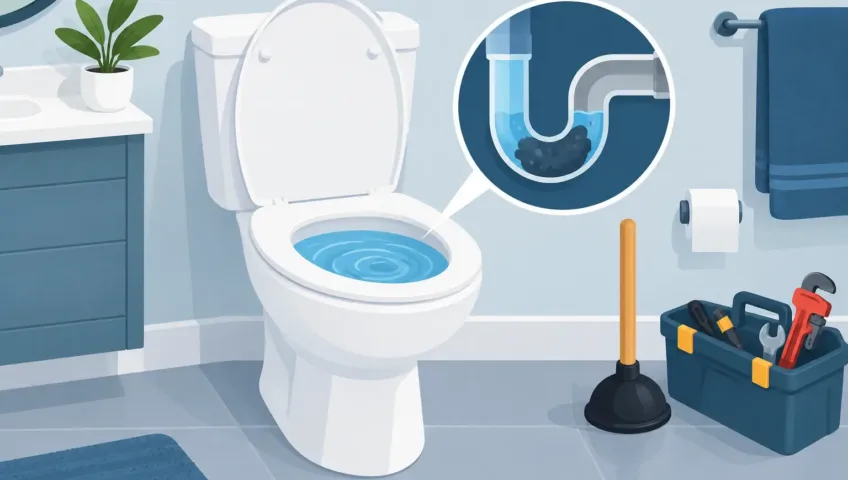
A toilet that works one day and backs up the next is more than an inconvenience. If your toilet keeps blocking, there is usually a reason beyond a one-off excess of paper. Acting early can prevent an overflow, unpleasant smells and wastewater finding its way onto your bathroom floor. Don’t panic – a few sensible checks can help you decide whether it is a simple local blockage or a problem further along the drain.
Start by spotting where the problem is
Flush once and watch what happens. If the bowl water rises, drains away slowly or gurgles before settling, stop flushing. Repeated flushing is the quickest way to turn a manageable blockage into a messy overflow.
A blockage affecting only one toilet is often within the toilet trap or the short pipework immediately behind it. If the bath, shower, basin or downstairs toilet are also slow to drain, gurgling or backing up, the issue is more likely to be in the branch pipe or the main drain outside. That distinction matters: a plunger may clear a local obstruction, but it will not remove a collapsed drain, roots or a serious build-up further down the line.
The common reasons a toilet keeps blocking
Too much paper or something that should not be flushed
Toilets are designed for toilet paper and human waste only. Wipes labelled ‘flushable’, kitchen roll, cotton buds, sanitary products, nappies, dental floss and tissues do not break down in the same way. They can catch in bends, join together with grease and paper, then form a stubborn blockage.
A sudden blockage after children have used the toilet can also mean a small object has been flushed accidentally. Air freshener holders, toilet freshener blocks, toys and even toothbrushes can lodge out of reach. Avoid poking around with improvised tools, as this can push the item deeper or damage the pan.
A blockage in the toilet trap
Every toilet has a curved internal section known as the trap. It holds water to stop drain odours entering the room, but it is also a common point for paper and wipes to become caught. This usually causes a slow flush or a water level that rises before gradually dropping.
A proper toilet plunger can often help. Use one with a flange that creates a seal over the outlet. Make sure there is enough water to cover the rubber cup, then use steady, controlled pushes and pulls for around 20 seconds. If the water level falls, wait a few minutes and test with one careful flush.
Scale, poor flow or an older toilet
In hard-water areas, limescale can build up in the rim jets and reduce the volume and direction of water entering the bowl. A weak flush may leave waste behind and make blockages more likely over time. Older cistern components can also fail to release enough water.
If the toilet has always struggled to clear properly, it may be a flushing performance issue rather than a blocked drain. If it has only recently started happening, a restriction in the pipework is more likely. A drainage engineer can assess both without guesswork.
Problems in the soil pipe or outside drain
When several fixtures are affected, or a toilet blocks repeatedly despite being cleared, the fault may sit beyond the bathroom. Common causes include fat and debris build-up, wipes in the drain, displaced joints, tree roots entering damaged pipes or a drain that has cracked or partially collapsed.
This is particularly common in older properties, rented homes with a history of drain misuse, and commercial premises where toilets receive heavy daily use. The visible blockage may clear temporarily, while the underlying restriction remains. That is why a repeat problem deserves a proper investigation rather than another round of plunging.
What you can safely try first
If there is no risk of overflowing and only the toilet is affected, start with a plunger. Do not use excessive force, and do not continue if the bowl water keeps rising.
A toilet auger can sometimes remove a blockage just beyond the trap, but it needs careful use. Cheap drain rods and metal hooks are a poor choice inside a toilet because they can scratch the ceramic or snag in the pipe. Chemical drain cleaners are also best avoided. They rarely shift a solid toilet blockage, can splash back, may harm seals and pipework, and make any later work more hazardous for the engineer.
If you know an item has been flushed, if the toilet blocks again soon after plunging, or if other drains are showing symptoms, stop there. The safest next step is professional drain clearing.
Signs you need a drainage engineer now
Some toilet problems should not wait. Contact a drainage specialist promptly if wastewater is close to the rim, sewage is backing up into a shower or bath, or there is a strong drain smell inside the property. The same applies if more than one toilet or drain is affected, especially on the ground floor.
For landlords, property managers and business owners, a repeated blockage is also a hygiene and continuity issue. A restaurant, office, shop or shared residential building may need rapid attention before facilities become unusable or customers and staff are exposed to wastewater.
An experienced engineer can use professional rodding or high-pressure water jetting to clear the line safely. Where the cause is uncertain or the blockage returns, a CCTV drain survey can show exactly what is happening underground. It can identify roots, displaced pipes, scale, cracks and collapses without unnecessary digging.
How to reduce future toilet blockages
Prevention is straightforward, but it needs everyone in the property to follow the same rules. Keep a small bin next to the toilet for wipes and sanitary waste, even where packaging claims a product is flushable. Use toilet paper sensibly, and teach children never to flush toys, tissues or household objects.
If your home has recurring drainage issues, regular drain cleaning can remove developing build-up before it causes an emergency. For commercial sites, planned maintenance is often the sensible trade-off: a scheduled clean is easier to manage than a blocked customer toilet during opening hours.
Older drains, properties near mature trees and buildings with a history of repeat blockages may benefit from a CCTV survey even after the immediate problem has been cleared. It is not always necessary after a single minor blockage, but it can save repeated call-outs where there is evidence of a structural fault.
Get the cause fixed, not just the bowl cleared
A plunger is useful for a simple blockage, but a toilet that repeatedly backs up is telling you something. The priority is to protect your property, avoid an overflow and find out why the obstruction is returning.
Absolute Drainage provides 24/7 support for blocked toilets and drains, with trained engineers who explain the problem before work begins. Whether it is one stubborn toilet, a blocked outside drain or a fault revealed by CCTV, getting a clear diagnosis gives you the best chance of keeping the problem from coming back.